
Accommodations
Rooms
Cambria California
9 Rms, 20+ Guests
805-878-4561 - Primary
or 805 286-5824
Private Rooms & Entire House Accommodations
Cozy, private, hide-a-way, unique; are some of the terms used to describe our accommodations at the Pickford House. Guests appreciate all the comforts one has come to expect, including but not limited to:
Private Bath | Extra Blankets | Ruffled Pillows | Television


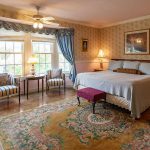


Mary Pickford
The Mary Pickford room, one of our premier rooms, features French blue satin draperies with rose accent hues. French bisque lamps light the bedsides. The antique fireplace mantle is the framework for a portrait of Mary Pickford. The large bay window provides a cozy seating area for sipping and reading. A beautiful Parrish print hangs over the custom dual headboard. The Mary Pickford room is the largest in the house and can accommodate a rollaway bed.
More Info
 Gladys Louise Smith (April 8, 1892 – May 29, 1979), known professionally as Mary Pickford, was a Canadian-born American film actress and producer with a career spanning 50 years. She was a co-founder of the Pickford–Fairbanks Studios with Douglas Fairbanks and the United Artists studio with Fairbanks, Charlie Chaplin, and D. W. Griffith, and she was one of the 36 founders of the Academy of Motion Picture Arts and Sciences who present the yearly “Oscar” Awards ceremony.
Douglas Fairbanks Room
At The Pickford House the Douglas Fairbanks room is a large and handsomely furnished resting place. Doug lived very much like a great and beloved king and you will too with the huge king size bed, fireplace, and sumptuous antiques.
More Info
Fairbanks really enjoyed making movies from the start of his screen career. From 1915 to 1920, he tried his hand at occasionally adapting his own scenarios. By the time United Artists (the company he partly founded, in 1919, and actively participated in) was operating very successfully, he found his niche in costume pictures. He knew what kind of script worked best to showcase his persona. Beginning in 1922, he resumed writing and wrote many of his own entertaining and creative story lines under the pseudonym of Elton Thomas (his two middle names). These feature films included: Douglas Fairbanks in Robin Hood (United Artists, 1922), The Thief of Baghdad (1924), The Black Pirate (1926), The Gaucho (1927) and The Iron Mask (1929).
Doug lived very much like a great and beloved king. He was an active member of society and worked towards the betterment of his beloved Southern California, as well as the movie industry – co-founding Beverly Hills, United Artists and the Academy of Motion Picture Arts and Sciences. He was a world traveler and, with his queen Mary Pickford, thrilled the imagination of people all over the globe. It seemed as if this dynamic individual would outlive all his contemporaries.

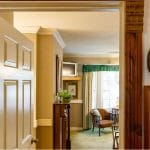


Rudolph Valentino Room
One of the Pickford House’s premier rooms, the Valentino features a large photo, from one of the actors’ films, over the antique fireplace mantel. The antique furnishing and accessories are uniquely matched to the royal colors that enhance the romantic setting. The room has two custom double beds and can accommodate four persons, plus will hold a fold-away bed as well. The mountain views are soothing and beautiful.
More Info
Clara Bow
Named for the famous “IT” girl, the Bow room shows the femininity of ruffled pillows and curtains, while acknowledging the masculinity of strong accent colors on the walls and bedspread, it is favored by those who like the “Old Fashioned Look” of the decor used by many of our ancestors. Early American antiques and a fresh flowers are features of the room. The colors are antique rose, soft mauve and deep wines and greens.
More Info
 The “jazz baby” personified, Clara Bow (1906-1965) became one of Hollywood’s brightest lights of the ’20s. Saucy and pert, Clara was dubbed ‘The “It” Girl’ by Elinor Glyn and chosen to star in the film version of Ms. Glyn’s famous novel. While nothing more than good old sex appeal, “It” symbolized the tremendous progress women were making in society, and leading the way was Clara Bow.
Success followed success, with Clara’s popularity growing from such films as Mantrap, Kid Boots, Dancing Mothers, and Wings. But it was 1927’s grand-slam smash It which made Clara Bow Paramount’s number 1 star, and the most famous name in Hollywood.
Contrary to popular belief, Clara Bow successfully made the transition to talkies with such roles as Call Her Savage and Hoopla. She retired from films in 1933 to become a full-time wife and later, full-time mother to two sons, Tony and George.


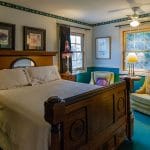



John, Lionel & Ethyl Barrymore
Dominated by its antique queen size bed, the room dedicated to the family Barrymore features the etchings of Lionel Barrymore and photography of John Sr., and Ethyl. The sunny end room is done in tones of green and yellow with black draperies for those who wish to sleep in. A view of the surrounding hills can be seen from the seating area. The room is small and cozy and features the Pickford House’s only queen bed which was custom made to fit on the very spectacular bed frame. Cable TV are in place to enhance your stay.
More Info
Ethel Barrymore (Ethel Blythe) actress
Born: 8/15/1879
Birthplace: Philadelphia
Best known as a stage actress, she appeared in The Corn Is Green (1940-42) and has a Broadway theater named in her honor. She won an Academy Award for None but the Lonely Heart (1944).
John Barrymore (John Blythe) actor
Born: 2/15/1882
Birthplace: Philadelphia
Film and stage actor known for his acting skills and tempestuous personal life. In 1922 and 1923, he gave 101 performances as Hamlet. His films include A Bill of Divorcement (1932) and Twentieth Century (1934).
Lionel Barrymore (Lionel Blythe) actor
Born: 4/28/1878
Birthplace: Philadelphia
An Academy Award-winning actor, he appeared in the films Free Soul (1931) and Dinner at Eight (1933).
Norma Talmadge Room
Dedicated to the three Talmadge sisters, Norma, Constance and Natalie. The Talmadge is a bright cheerful room with a dual king bed. It features lovely authentic antiques which add to its beauty. The colors are apricot, orange to yellow tones with green accents. This sunny, cheerful room is a favorite of many guests who return regularly for its sunny disposition and restful atmosphere.
More Info
Short Bio
October 30, 1920
EXCLUSIVE TO THE “PICTURE SHOW.”
For the first time the romantic life story of Norma, Natalie, and Constance Talmadge has been written and will appear exclusively in the “Picture Sow.” The early struggles of these girls, before they were stars, make most fascinating reading, especially as they have recently visited Great Britain.
The Editor
Read this first.
A wee little mite gave a rendering of “Sunshine in Paradise Alley” one afternoon at a seaside hotel. The singing was out of tune, but nevertheless, sweet. This was the debut in public of Norma Talmadge. Years after, when she and her two sisters, Natalie and Constance, were schoolchildren, the three girls gave a performance for their mother, Peg, and some friends, of a small play. Norma’s acting was so remarkable that her audience predicted a brilliant future for her. And they were not far wrong! When Norma was nearly fifteen she applied at the Vitagraph Studio, and was taken on as an “extra.” After a year at the studio, in which she got very disheartened, Norma was given a chance. She gave a wonderful rehearsal of her part before her sister Constance.
Norma makes good.
After the bedroom rehearsal with Constance as her only audience, Norma slept well. The next morning she went to the studio as usual. She was feeling nervous and yet hopeful. Young as she was, she had the true artist’s secret confidence in her own powers. Deep down in her heart, she felt that, given her chance, she could make good. And now her chance had come. She had a real part.
But there was always the risk of failure. Something might go wrong. A thousand and one things might happen to prevent her from making just the impression she wanted to make, and which she knew she could make if all went well. So she was anxious and conscious of a certain mental strain as she entered the studio. She was quite at home there now, and had many friends, but she was still looked upon as a beginner, just one in the crowd.
To-day she conversed little with her associates, but stood apart, preoccupied with her own thoughts. She had to wait some time, for the big scene of the play was being taken first, and in this she does not appear. The scene gave some trouble. For some reason or other, the lady who took the leading part was in a bad humour and nothing went right. The scene was taken over and over again, and the producer was almost driven to despair.
“Now, Miss Talmadge!”
Norma was startled by the sudden mention of her name. Mr. Wilmore’s voice was unusually sharp… Read more »

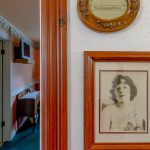




Lillian Gish Room
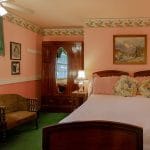
The peach satin draperies in the Gish room reflect the simple elegance of Ms Gish’s time and personality. The room’s dual king bed with soft print bedspread and cozy seating offers spacious comfort of the guests, while the fabulous antique armoire makes a statement of quality and substance that seems to dominate this special room. Ms Gish has been known to gently remind guests of her occasional presence, especially near her birthday. The uniquely decorated ceiling may at times reflect her date of birth, 10/14/1893. Ms Gish was last seen in Cambria, which she loved, when she was 93 years old and was said to be as lovely as ever. We cherish her.
More Info
Short Bio
Birth Name: Lillian Diana de Guiche
Born: October 14, 1893 in Springfield, Ohio
Died: February 27, 1993 in New York, New York
Not only was Lillian Gish born in the right era, but she was also born with the ethereal beauty and grace to make her a star in the silent film industry. If Mary Pickford was the silent cinema’s greatest personality, Lillian was its greatest actress.

A consummate actress, Lillian seemed to take delight in suffering for the art form that became her obsession. In order to experiment, Lillian worked in extreme conditions such as starvation, intense heat and bitter cold. Soon, she became the quintessential silent screen heroine, lovely and open to suffering. However, despite her characters’ apparent weakness, Lillian’s performances also let their inner strengths shine through.
Harold Lloyd Room
Our Harold Lloyd room is richly decorated with period antiques, including a working ceiling fan. You will love the satin bed spread, armoire, tasseled lamp shades and warm colors that fill this quiet end room.
Harold Clayton Lloyd (April 20, 1893 – March 8, 1971)
was an American film actor and director, most famous for his silent comedies.
More Info
Harold Lloyd ranks alongside Charlie Chaplin and Buster Keaton as one of the most popular and influential film comedians of the silent film era. Lloyd made nearly 200 comedy films, both silent and “talkies”, between 1914 and 1947. He is best known for his “Glasses Character”, a resourceful, success-seeking go-getter who was perfectly in tune with 1920’s era America.
His films frequently contained “thrill sequences” of extended chase scenes and daredevil physical feats, for which he is best remembered today. Lloyd hanging from the hands of a clock high above the street in Safety Last! (1923) is one of the most enduring images in all of cinema. Lloyd did many of these dangerous stunts himself, despite having injured himself during the filming of Haunted Spooks (1920) when an accident with a prop bomb resulted in the loss of the thumb and index finger of his right hand (the injury was disguised on film with the use of a special prosthetic glove, though the glove often did not go by unnoticed).
Although Lloyd’s individual films were not as commercially successful as Charlie Chaplin’s on average, he was far more prolific (releasing twelve feature films in the 1920s while Chaplin released just three), and they made more money overall ($15.7 million to Chaplin’s $10.5 million).




Charlie Chaplin
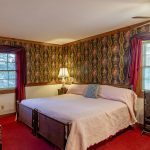
A cozy, private hide-a-way at the Pickford House. Guests appreciate its private entrance and separation from the rest of the mansion. All other rooms are on the second floor (no elevator). All the comforts one has come to expect are included:
Private Bath | Extra Blankets for Cold Cambria Nights
More Info
Charlie Chaplain
 Sir Charles Spencer Chaplin KBE (16 April 1889 – 25 December 1977) was an English comic actor, filmmaker, and composer who rose to fame in the era of silent film. He became a worldwide icon through his screen persona, “The Tramp”, and is considered one of the most important figures in the history of the film industry. His career spanned more than 75 years, from childhood in the Victorian era until a year before his death in 1977, and encompassed both adulation and controversy.
Visit the Central Coast in Style
We Have Vacancy!
Always do right - this will gratify some and astonish the rest...
-Mark Twain


